Did you know most Ohio homeowners never appeal their property tax value? I ran a poll on my channel asking exactly that — 354 people responded. Only 17% said yes, they'd appealed. 45% said no. And 38% said they didn't even know they could.
That last number is the real story. More than a third of homeowners are sitting on a tax bill they've never once questioned, simply because nobody told them the option exists.
Ohio gives you the right to challenge your county's number every year, for free, no lawyer required. Most people just don't know it. I've covered how broken Ohio's property tax system can get — this guide is the practical fix. I'm going to walk you through exactly how to do it — what counts as real evidence, how to file, and what actually happens at the hearing.
Source: poll of 354 respondents, Ohio Housing Nerd YouTube channel.
- Your goal: confirm you're paying tax on the correct value of your home.
- The deadline is fixed by state law: January 1 – March 31, every Ohio county, no exceptions.
- You're disputing your home's value — not your tax rate or your bill.
- No lawyer, no fee. Filing the form costs nothing.
- Evidence wins, not opinion. A recent sale, an appraisal, or comparable sales — not "this feels too high."
- A win sticks for years, not just one tax bill.
Buying or selling in Ohio? Let's talk.
What Does It Mean to "Appeal" Your Property Value in Ohio?
Ohio counties charge your property tax based on your home's value. That means it's important to make sure the value your county has on file is accurate. Getting this right can save you money for years to come.
The alternative is to just hope the county got it right. That's lazy. Don't be lazy.
This guide walks you through exactly how to check it, and exactly how to fix it if it's wrong — step by step.
Step 1: Find Your Home's Assessed Value
Go to your county auditor's website and search for your property. Every county in Ohio offers this service online. You'll be able to find your home's market value there. If you want to see how your area's values have been trending overall, my Ohio housing data page tracks that county by county.
You can also find it on your property tax bill, either the digital copy on the county's site or your hard copy in the mail.
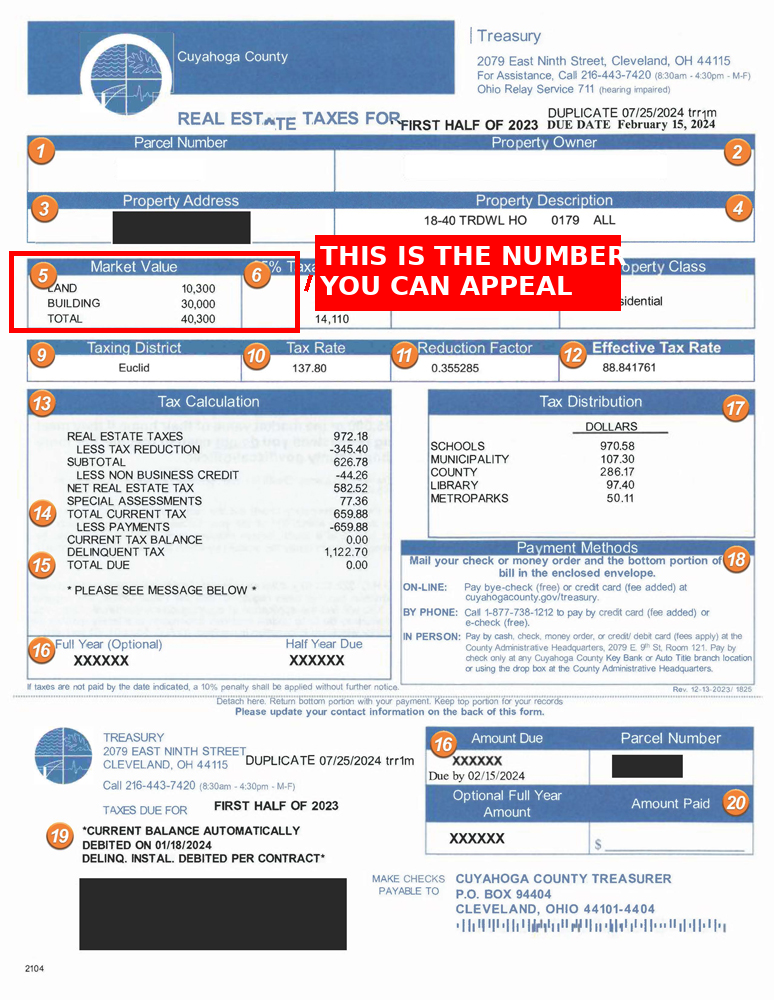
Sample Ohio property tax bill, courtesy of the Cuyahoga County Treasurer. The highlighted box shows where to find your Market Value — the number you can appeal.
Can't find it online? Call your county auditor's office. They can help — and many will just email you the information directly.
Once you know your market value, the next step is confirming it's actually accurate, based on real market sales.
Step 2: What Proof Do I Need to Appeal My Ohio Property Tax Value?
There are a few ways to build your case.
If you bought your home in the last couple of years, use your closing statement or sales contract as evidence. Can't find them? Contact the title company you closed with, your realtor if you used one, or your lender if you have a loan. What you're looking for is the actual purchase price of the property.
If you didn't buy recently, you'll need to find comparable sales. A comparable sale is simply a nearby home that actually sold — not one that was foreclosed on or gifted to someone.
To find comps, use a site like Zillow or Realtor.com, or check your county auditor's website. You're looking for 3 to 5 closed sales within a 1-mile radius of your property. The closer and more recent, the better — try to stay under 12 months. Make sure the comps you select are similar in style, size, and condition. The more accurate your comps are, the better your chances. If you want context on where your local market's been headed, check my market updates for your area.
If your home has real condition problems — a bad foundation, roof failure, or other significant damage — take photos and get a written repair estimate. This helps prove your home isn't worth what the county thinks. Normal wear and tear, like an aging roof, usually doesn't count — the county assumes that's already factored in.
If you can't find comps, or you just want help, you can hire an appraiser. It generally runs $300-$600. The appraiser will come out and give you an assessment of your property's market value. Appraisals carry a lot of weight with the county when protesting your value — though they're not required. You can absolutely do this on your own.
Step 3: File Your Challenge and Make Your Case
Fill out DTE Form 1. Here's a sample of the form. Your county should also have its own copy available on its auditor's website.
Submit it between January 1 and March 31. That window is set by state law, and every county in Ohio has to follow it — no exceptions.
It's free. You don't need an attorney to file.
After you file, you'll get a hearing. It's usually short, 15 to 30 minutes. Stay calm, be respectful, and treat it like a business meeting. The people who lose are usually the ones who get emotional. Come armed with your comparable sales data, and remember why you're there — you're proving the value of your property, not complaining about your tax bill. Stick to the evidence.
If you want a record of what was said, bring your phone and record it. It's cheap insurance, and it means there's no confusion later about what evidence you presented.
If you'd rather not go through this alone, you can hire an attorney to help — just weigh the cost against what you'd actually save if your appeal succeeds. And if you're weighing whether to fight your value or just sell, reach out — that's exactly the kind of call I help people make.
FAQ
Do I need a lawyer to appeal my property taxes in Ohio?
No. This process doesn't require a lawyer, though you always have the option to hire one if you want help.
What's the difference between market value and taxable value?
Market value is what the county says your home would sell for today. Taxable value — sometimes called assessed value — is 35% of that number. That's the amount your tax rate actually applies to.
Can I appeal every year?
No. Ohio generally allows one appeal per property every three years. There are exceptions — if you recently bought the property, made major improvements, or your home was damaged — but outside of those, you get one shot per three-year cycle, so make it count.
What if I miss the March 31 deadline?
You'll have to wait until the next filing window opens the following year.
Do all Ohio counties use the same deadline?
Yes. But some counties offer additional review opportunities before the formal window even opens. Check with your local county auditor.
What happens if I win?
Your county will reset your property's value, and you'll be taxed on the new number moving forward.