If you fall behind on your Ohio property taxes, your county doesn't just come after you. They can sell your debt to a stranger — usually an out-of-state investor you've never heard of.
Right now, over 570,000 Ohioans are behind on their property tax bill — and that number has jumped fast. In May 2026, it was 350,671. By June, it spiked to 569,586. As of July, it's sitting at 570,411, according to PropStream data.
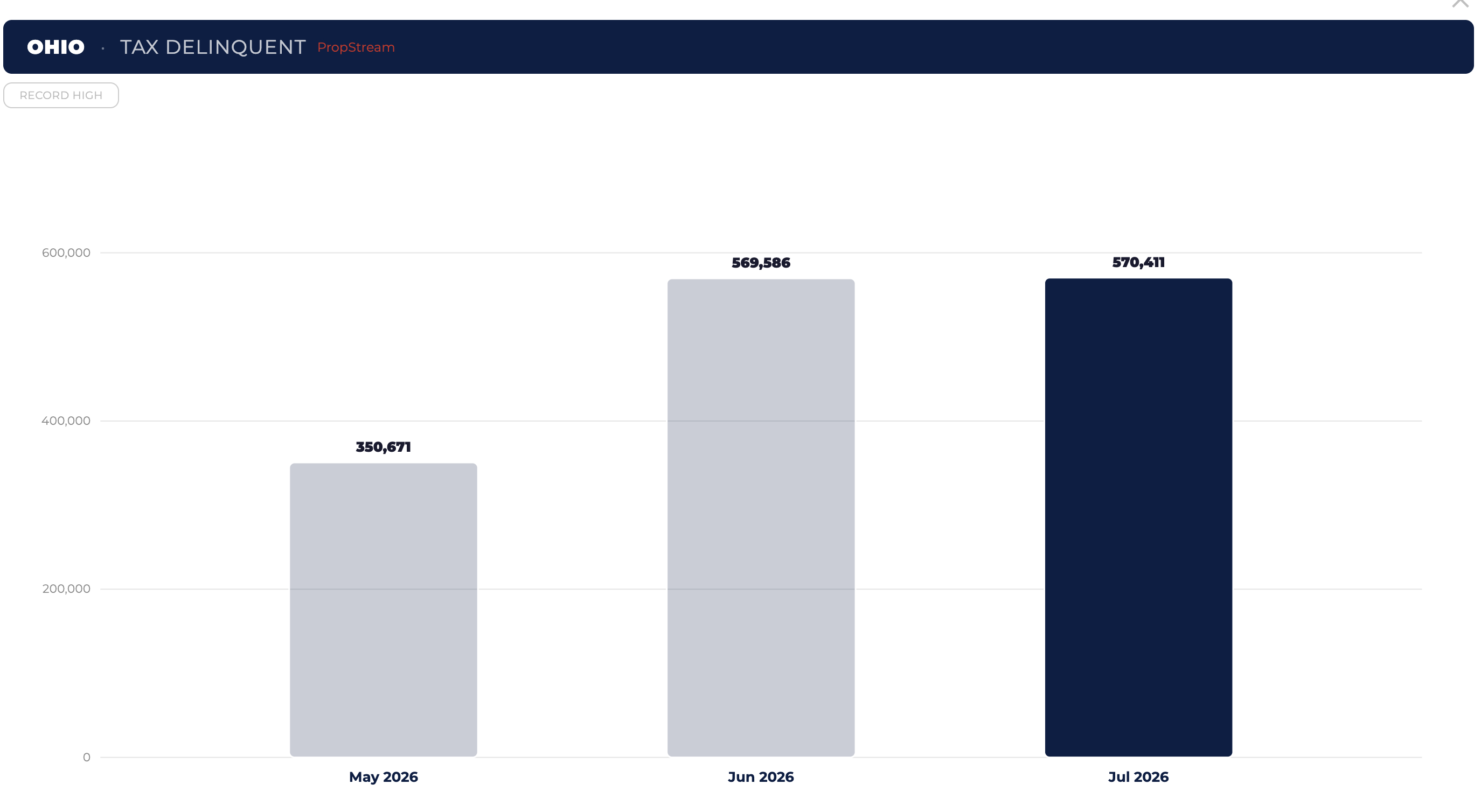
Source: PropStream
Here's the part that should really bother you: many of these people already paid off their mortgage completely. Their home is fully theirs. But in some cases, their annual property tax bill is now higher than what their old mortgage payment used to be.
Delinquency has been growing for years, and it left me with one question: why aren't we seeing more foreclosures? Ohio's tax and mortgage foreclosure numbers are still running well under historical averages — mostly a leftover effect of pandemic-era protections that are only now starting to unwind. But tax foreclosures were never under those protections. So that explanation doesn't fully hold up.
Here's what I found instead: counties aren't selling these tax debts one at a time to regular Ohio buyers. They're bundling them into blocks and selling them at scale — to investors from all over the country, sometimes the world.
In this update, I'll walk you through exactly how a $2,000 tax bill can balloon into $10,000, how counties are getting away with it, who these investors actually are, and how you can protect yourself.
- Falling behind on your Ohio property taxes can trigger fees and penalties that balloon your bill by thousands.
- Counties sell that debt to investors and get paid upfront — so they're never on the hook for collecting it themselves.
- House Bill 493 would stop these sales to out-of-state investors, but it's already been watered down and has a long way to go.
- Foreclosures are low right now, but expect that to change as delinquency works through the system.
- You can protect yourself — from checking your escrow account to protesting an inflated property value.
Join the other housing nerds who get the data before the news does. →
What Happens If You Don't Pay Your Property Taxes in Ohio?
In Ohio, missing a property tax payment triggers an immediate penalty plus annual interest from your county. If you're still behind after one year, the county can sell your tax debt to a private investor — often based out of state — who can charge you even more interest, and eventually foreclose on your home.
Let's say you get a $2,000 property tax bill in the mail. If you can't pay it, you fall behind. The county hits you immediately with a 10% penalty, then adds 8% annual interest. By the end of year one, your $2,000 bill is now $2,376.
What Is a Property Tax Lien, and How Does Ohio Sell Them?
After a year of delinquency, Ohio law lets the county sell the rights to your home in the form of a tax lien. Think of it as debt on your property — and the county can sell that debt, along with the rights tied to it, to a private investor.
Counties do this so they can collect on delinquent property tax quickly, without waiting around for you to pay. And they don't sell these one or two at a time. They bundle up entire lists of delinquencies into blocks — sometimes worth millions of dollars — and sell them all to one investor in a single transaction.
Once that sale goes through, the investor is the one who starts charging you interest and penalties. Not the county.
How Much Can a $2,000 Property Tax Lien Actually Grow To?
The investor's goal isn't to help you catch up. It's to make money. So they tack on 18% interest per year — the maximum allowed under Ohio law — and they can keep that going for up to six years.
That means a tax bill that started at $2,000 can easily balloon to $10,000. And don't forget — through this entire process, you're still obligated to pay your ongoing property taxes too. If you miss one year's payment, you're still on the hook for year two, three, four, and five. If those go delinquent as well, the bill spirals completely out of control.
I've sat in living rooms with homeowners who are scared to death because their property tax bill went from a few thousand dollars to over $20,000. At that point, there's zero realistic path for them to ever catch up.
After six years, the investor has the right to foreclose on your property. When they start that process, they tack on penalties and legal fees — usually a few thousand bucks. That's how a $2,000 tax bill can turn into a $10,000 tax bill fairly easily.
Why Aren't We Seeing More Tax Foreclosures in Ohio Right Now?
Ohio typically runs 30,000 to 40,000 foreclosures a year, according to my own research. Right now, we're sitting at around 16,000. COVID-era moratoriums are certainly part of that lower number.
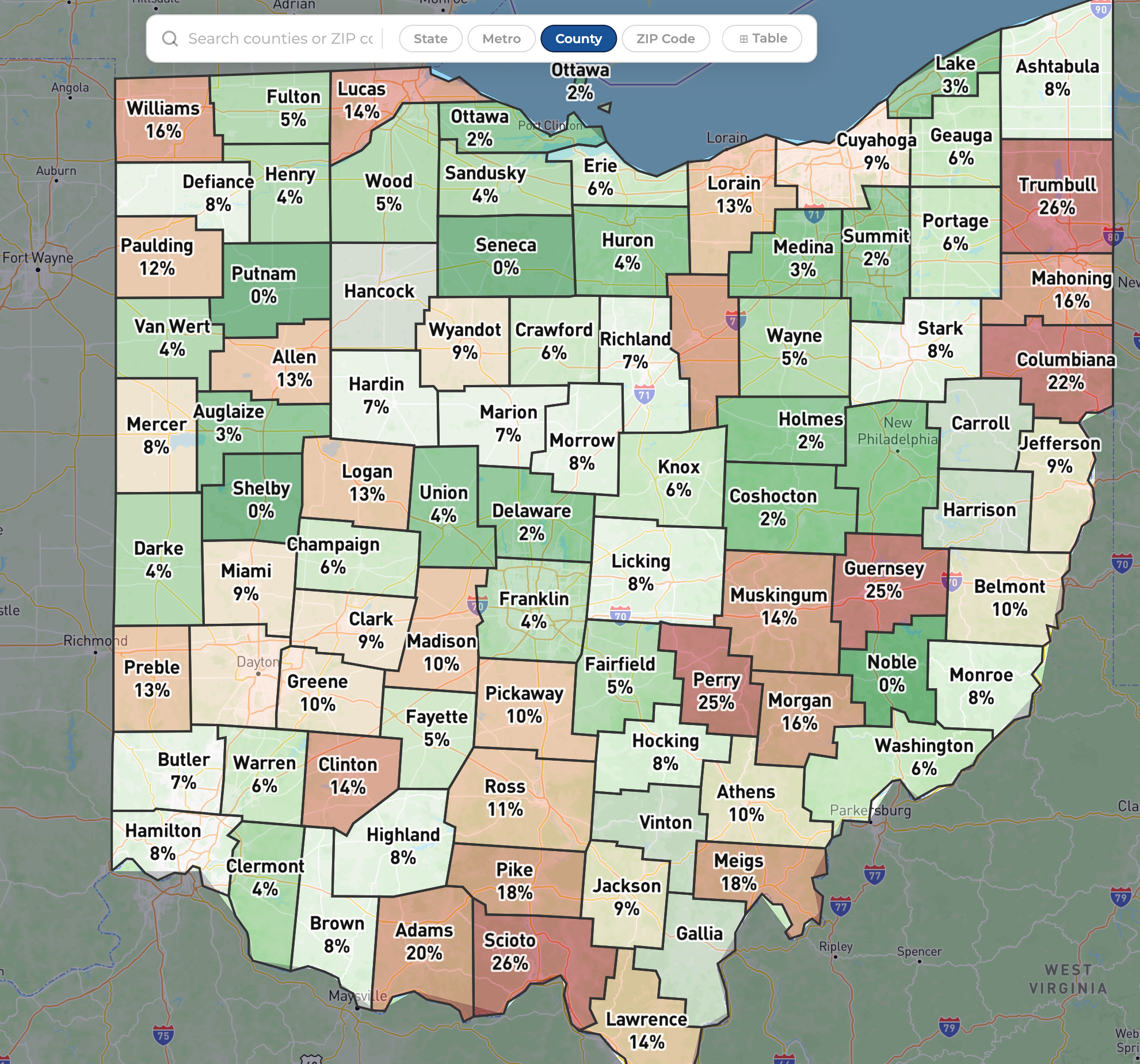
Source: jassonfarrier.com/ohio-housing-data
But with all the tax delinquency we've seen build up, you'd think we'd be seeing more foreclosures by now — not fewer. My guess: we just haven't hit that six-year mark yet. A lot of this delinquency is still sitting in collections, waiting to hit the auction block.
There may very well be a dam of tax foreclosures building in Ohio right now, just waiting to break. If you want to track it yourself, my Ohio data page shows foreclosure and tax delinquency numbers by county.
Join the other housing nerds who get the data before the news does. →
Who's Actually Buying Ohio's Property Tax Liens?
As an investor, I wanted to figure out who was actually buying these tax liens — because for the life of me, I couldn't find out how to participate. I figured there had to be vacant, abandoned homes on these delinquency lists that I could buy and fix up. Instead, my attempts kept hitting dead ends.
As I dug deeper, I found out why. Ohio counties do sell tax liens — but not to everyday investors, and not to homeowners. Instead, they package them up and sell them to out-of-state investors in massive blocks, usually worth several million dollars at a time.
Cuyahoga County, for example, sold $30 million in property tax liens to a single buyer: NAR Solutions, a private equity company based in Omaha, Nebraska. Another name that keeps popping up is Tax Ease Ohio — and despite the name, they're not even in Ohio. They're based in Texas.
The more I dug into these companies, the more mysterious they became. It looks like these organizations were set up specifically to buy tax liens from counties in Ohio, and likely in other states too. This isn't something counties advertise. They know the optics are bad. But now the cat's out of the bag.
Look — I have no problem with investors making money. As an investor myself, I want to make money too. But instead of giving in-state investors, and even prospective homeowners, the opportunity to buy these tax liens and reinvest those dollars back into the community, counties sell them under the table to massive out-of-state companies. It just doesn't seem right.
Is Ohio Doing Anything to Stop This? (House Bill 493)
So how much debt are we actually talking about here? I did some digging, and the Ohio Department of Taxation published a study showing delinquent property taxes and penalties hit $2.8 billion statewide in 2024. That's a pretty large number when you consider Ohio collects a total of $24 billion a year in property tax overall.
There's a bill in Columbus right now designed to "fix" this out-of-state grift. Sadly, it's mostly smoke and mirrors.
House Bill 493 would ban the sale of tax certificates in blocks — not just to out-of-state investors, but in-state investors too. Sounds good, right? Not so fast.
For one, it's not a law yet. Nothing has changed. But two — and this is the bigger problem — it's already been watered down with a strange exclusion: counties can still sell your tax debt to a private investor as long as you "consent" to it. Who in the world would actually agree to that? I'll tell you who: the person who doesn't fully understand what they're agreeing to. That's not a protection. That's a loophole, inserted to satisfy deep pockets.
There's also a carve-out for commercial property and non-owner-occupied homes — meaning those tax liens can still be sold to out-of-state investors regardless. Why the exclusion? Why should a business owner or a landlord be treated any differently than a homeowner? There's a family behind every one of those rental units. There's a family behind every one of those commercial buildings too. This is just another way to pander to voters while quietly satisfying the lobbyists.
One thing's for sure: if I were in charge of a county budget, I'd be terrified this bill actually passes. If it does, counties would suddenly be on the hook for managing all of that delinquency themselves — including foreclosures. Which, frankly, is how it should be. They're the ones who set the tax rates. They're the ones sending the bills. And right now, they're the ones getting paid upfront while ordinary taxpayers are left twisting in the wind.
I always wondered why counties weren't more nervous about rising delinquency. Now I know why — why be nervous when you're going to collect your money either way? If House Bill 493 actually goes through, counties will finally have to face the music. It'll be interesting to watch.
How Can You Protect Yourself From a Property Tax Lien in Ohio?
There's a push in Ohio to abolish property taxes entirely, and several watered-down bills have already passed in the last year to give homeowners "relief." But the reality is, today, you still have to pay your property taxes if you want to keep your property. And if you don't, Ohio counties can still sell that debt to an out-of-state investor.
So we have to focus on what we can control. Here are two practical things you can do.
Number one — don't fall behind. If you pay your taxes inside your mortgage, make sure you actually understand your escrow account, so you're not blindsided by a surprise bill. If you don't pay through your mortgage, set money aside each month so when that bill comes due, you're not scrambling.
Number two — and this is a big one — protest your property value if you think it's too high. A lot of you asked me to put together info on exactly how to do that, so I did. Fewer than 5% of homeowners ever bother appealing their assessment, but when they do, they win more often than not — Hamilton County saw a majority of appellants win every year from 2018 to 2023, and Cuyahoga County's most recent cycle saw 69% of complaints result in a value change.
Remember — the window to protest your property tax in Ohio runs January 1st through March. Now's the time to get ready.
FAQ
What is a property tax lien?
A property tax lien is a legal claim against your property for unpaid taxes, interest, and penalties. It gives the lienholder the right to collect the debt — and eventually foreclose if it goes unpaid.
Can I buy a property tax lien in Ohio?
Not easily. Ohio counties typically sell tax liens in massive blocks, worth millions of dollars, to large investment firms — not individual investors.
How do I protest my property value in Ohio?
You can file a complaint with your county's Board of Revision if you think your home's assessed value is too high. I've got a full step-by-step guide on how to do exactly that.
What's the deadline to protest my property taxes in Ohio?
The window to protest your property value in Ohio runs from January 1st through March 31st each year.
How does a tax lien foreclosure work in Ohio?
Once an investor buys your tax lien, they can foreclose after one year, tacking on court costs and legal fees that can add thousands to what you owe.
What is House Bill 493, and would it stop tax lien sales?
House Bill 493 would end the sale of tax certificates to investors, but it's already been watered down — allowing sales with homeowner "consent" and excluding commercial properties.
Sources
- Ohio Revised Code 5721.32 — Sale of tax certificates
- Ohio Revised Code 5721.30 — Interest rate on tax certificates
- Ohio Revised Code 5721.37 — Foreclosure by certificate holder
- House Bill 493, As Introduced — full bill text
- How to Appeal Your Ohio Property Tax Value — full guide
- Ohio Housing Data — foreclosure and delinquency tracker by county
- Local businessman upset over tax lien sales — Yahoo News
- Cazenovia Creek tax lien note sale — PR Newswire
- Cuyahoga County Should Stop Selling — The Angry Ohioan